
Pedestrian safety remains a critical focus for the Maryland Department of Transportation as the state works towards its Vision Zero goal of eliminating roadway fatalities and serious injuries. One of the most significant steps in that effort is the Pedestrian Safety Action Plan (PSAP), a data-driven initiative designed to identify and redesign corridors with the highest risk for pedestrian crashes across the state.
The MD 650 project marks a major milestone as Maryland’s first PSAP corridor to break ground. With a $15 million investment, the project will transform nearly 2.5 miles of New Hampshire Avenue in Montgomery and Prince George’s Counties, focusing on safety improvements for people walking, biking and traveling through the corridor. Earlier this month, the State Highway Administration announced five new corridors receiving safety projects in the next round of Maryland’s Pedestrian Safety Action Plan.
To learn more about the vision behind the project and what it means for communities statewide, we spoke with Kandese Holford, Director of Transportation and Mobility at MDOT Headquarters.

Kandese Holford, Director of Transportation and Mobility at MDOT Headquarters. (Victory A. Momoh/MDOT)
This interview has been edited for clarity and length.
Q: The MD 650 project is the first to break ground under the Pedestrian Safety Action Plan. Could you explain what the PSAP is and why it was created?
Kandese Holford: It’s an action plan designed to identify needs and recommend solutions. At its core, it asks: what do we need to do to make sure people aren’t dying on our roads?
Using Safety data we learned that many fatalities involved people who are not in cars. That told us we needed a focused pedestrian safety plan — to define the issues, identify where to start and guide our actions. We evaluated over 100 corridors statewide and identified the top 23. MD 650 — New Hampshire Avenue — was the first of those to break ground.
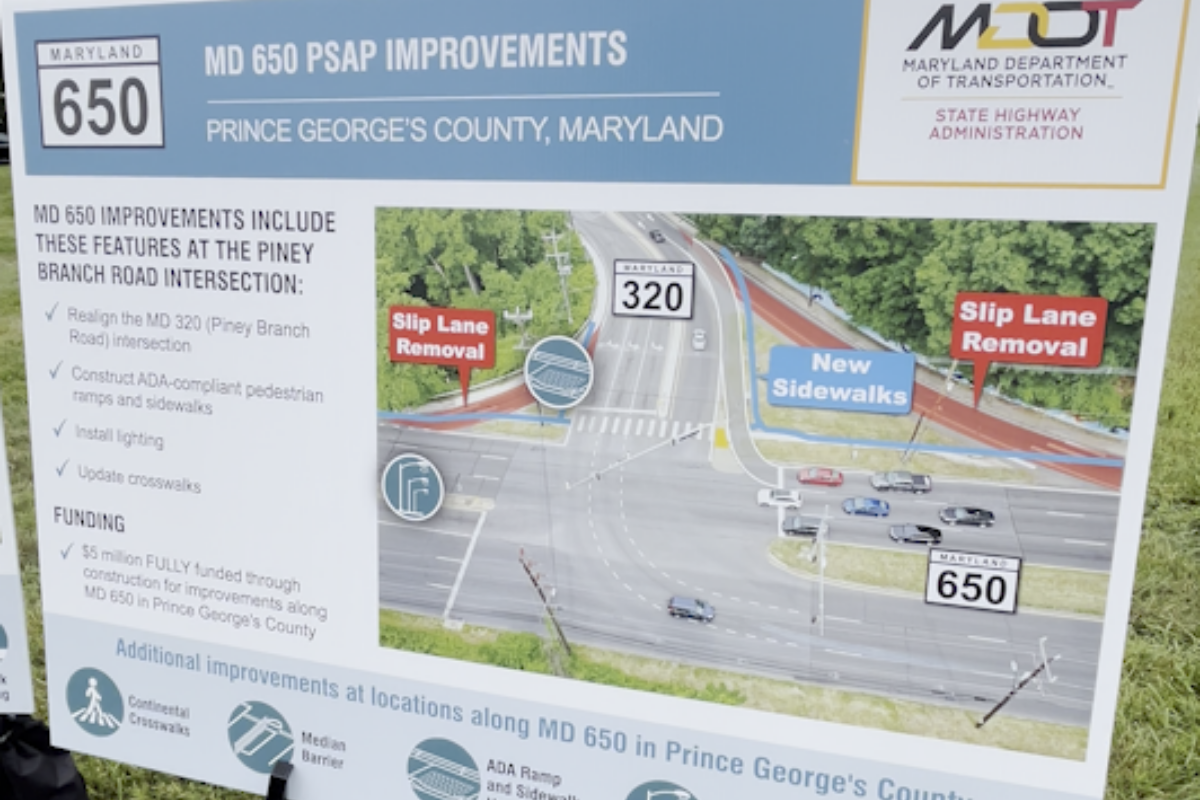
A board of the MD 650 Pedestrian Safety Action Plan project (MDOT)
Q: What was going through your mind during the groundbreaking ceremony held on July 15, 2025?
Kandese Holford: I was really excited that this is finally happening. It felt introspective — maybe even a bit retrospective — because I’ve been working on projects like this in Maryland for so long. Seeing something I helped conceptualize come to fruition is incredibly rewarding.
Q: Between 2018 and 2022, 1,019 crashes— including 45 involving pedestrians — were reported along this corridor. How is the Pedestrian Safety Action Plan designed to change these outcomes?
Kandese Holford: This may be the first plan of its type in Maryland to use crash data at a statewide level to determine where we should focus. We analyzed five years of historical crash data and also looked back nearly 10 years to understand best practices in pedestrian safety.
Our worst year for pedestrian deaths was 2007, and sadly, we saw similar numbers again around 2019 through 2021. Now, we’re starting to see a little bit of a dip. I believe that’s because of this deliberate, data-driven approach — understanding crash history statewide and prioritizing where to begin. The PSAP is one way we’re working to bend the curve toward Vision Zero.

Maryland’s Pedestrian Safety Action Plan. (David Trozzo/MDOT)
Q: What part of your job do you find most rewarding — especially the part people don’t often see — that reminds you of why you do this work?
Kandese Holford: I’ve been reflecting on that a lot lately. One thing people don’t always see is the amount of research that goes into every project —building the background so you can speak intelligently about it. Not just internally with colleagues, but when you’re in people’s homes and communities, talking about changes that directly affect them.
Q What is one key message you want people to keep in mind when it comes to making Maryland roadways safer?
Kandese Holford: It is all about personal responsibility. That mindset has changed my own behavior. I drive more than I bike or walk because of where I live. But regardless of how you travel, being mindful matters. It’s about paying attention, slowing down, and being conscious of others on the road.
Q: MDOT recently adopted the Serious About Safety initiative. What does that message mean to you, and what do you hope the public takes from it?
Kandese Holford: At some point in your day — whether you’re going to work, taking your kids to school or going to the grocery store, you’re on your feet. We want to make sure that’s safe. We hear about tragic incidents on roads, trails sidewalks where people lose their lives. It doesn’t matter where it happens, we all should care.
And if nothing else, when public projects are happening in your community, get involved. Learn what we’re doing and tell us what you want to see.
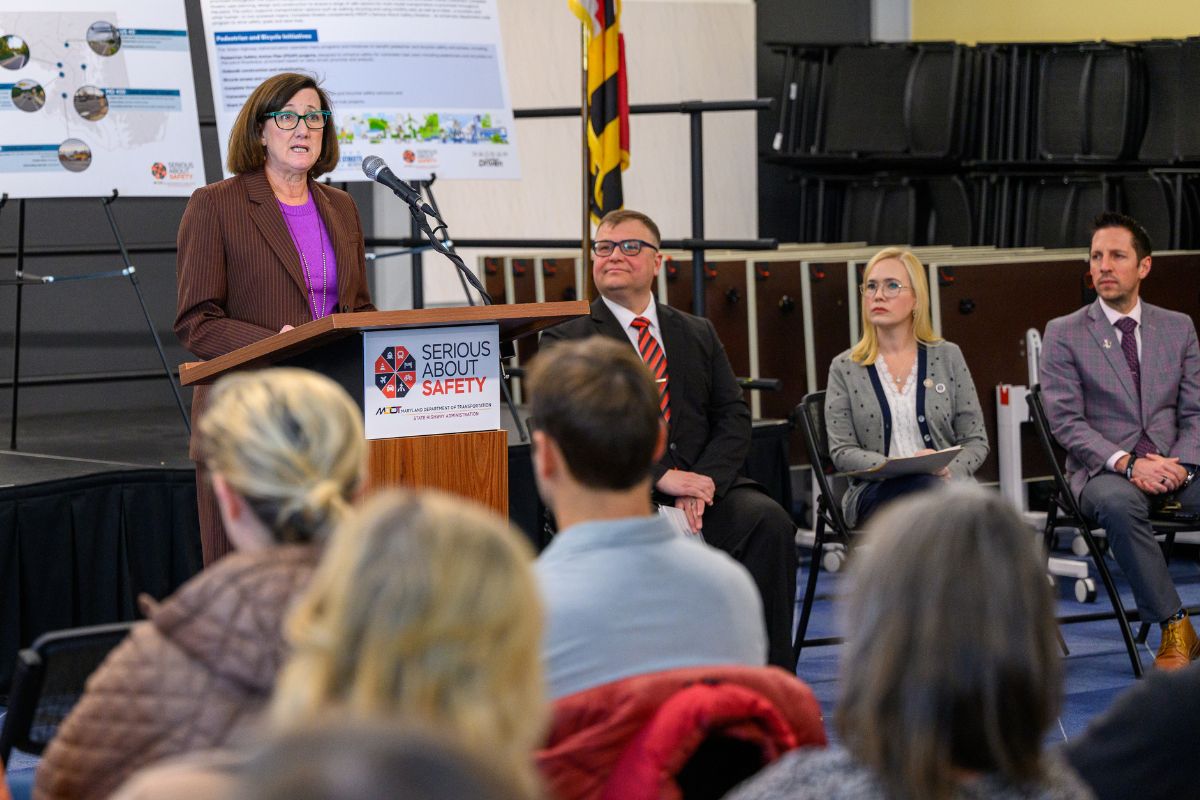
Leaders from MDOT, SHA and joined elected officials at the announcement of the five corridors receiving safety projects in the next round of Maryland’s PSAP. (David Trozzo/MDOT)
Victory Anase Momoh is a Public Affairs intern at the Maryland Department of Transportation.