
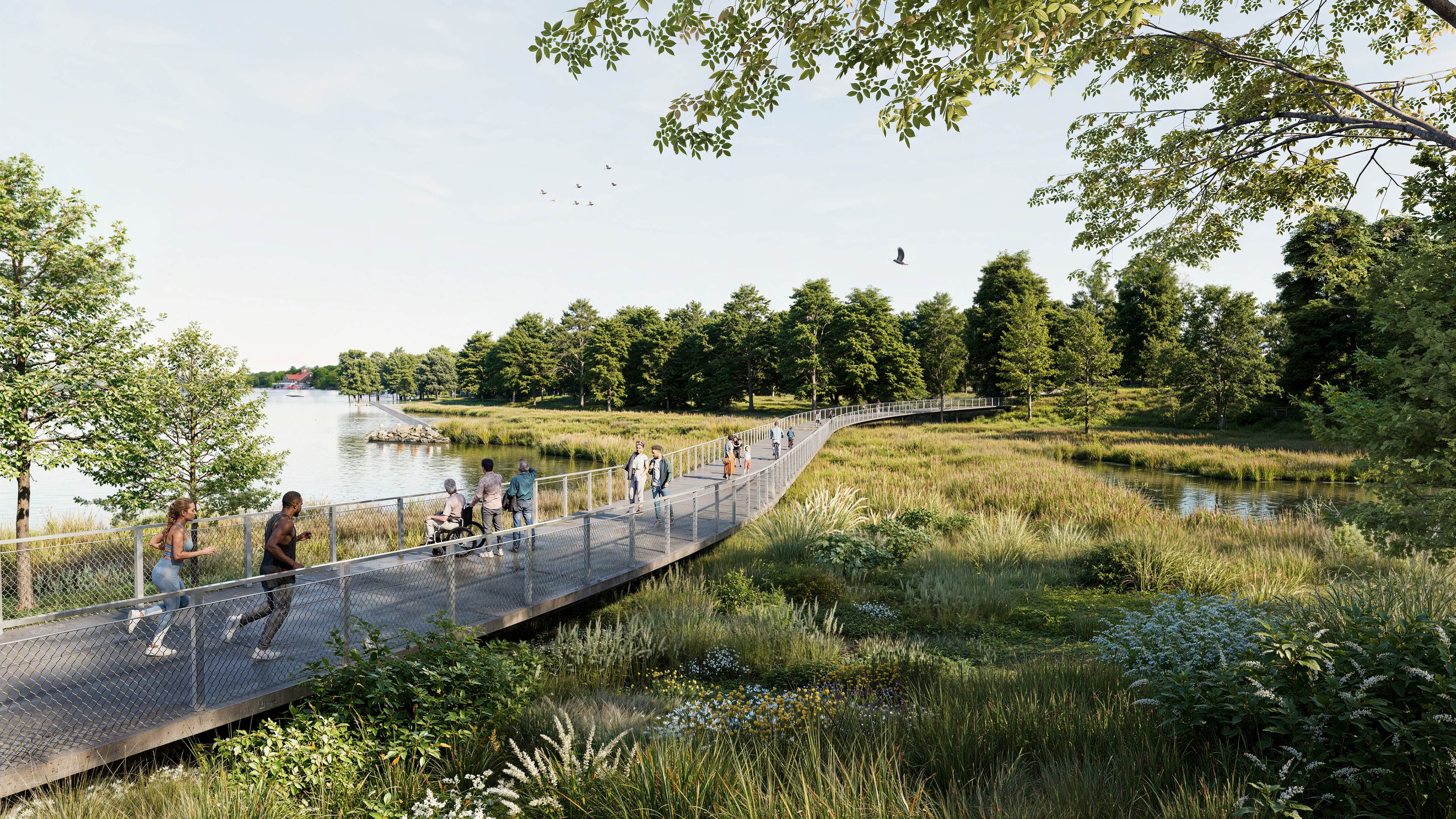
Conceptual rendering courtesy of the South Baltimore Gateway Partnership and Field Operations and is subject to change.
A new multimillion-dollar collaboration between the Maryland Department of Transportation State Highway Administration (SHA) and the South Baltimore Gateway Partnership will support expanded development and climate resilience in a critical section of the Baltimore City waterfront. SHA and the partnership, an organization that focuses on improving neighborhoods in South and Southwest Baltimore and the surrounding Middle Branch of the Patapsco River, recently signed a 15-year master memorandum of understanding to advance nature-based resiliency projects in the Baltimore Harbor Watershed. The agreement supports SHA’s commitment to advance projects that reduce runoff and support the health of the Chesapeake Bay and local waterways.
Through this partnership, SHA and the South Baltimore Gateway Partnership will fund and implement projects that manage stormwater runoff, improve water quality and strengthen climate resilience in and around the communities of South Baltimore. The Smith Cove Project, the first project under the agreement, will include:
- restoring existing degraded wetlands into approximately 4.5 acres of shallow extended detention wetland for stormwater management;
- constructing a pedestrian boardwalk that creates a safe, non-vehicular connection between Cherry Hill and Westport, including improved access to their respective Light Rail stations;
- reducing flood and storm surge risk by stabilizing about 2,800 linear feet of coastline, including approximately 1,250 linear feet of Living Shoreline; and
- reducing untreated discharges into the Middle Branch by capturing and treating runoff from approximately 314 acres.
Some work is expected to begin as early as this summer. SHA is one of the many funding sources, having committed $17 million from its capital program toward construction of the Smith Cove project.
“These collaborative, nature-based solutions help advance Maryland’s environmental goals while delivering meaningful benefits to local communities,” said Kevin Wilsey, Director of SHA’s Office of Environmental Design. “This partnership maximizes public investment and supports long-term resiliency in the Baltimore Harbor Watershed.”
The agreement also supports the partnership’s implementation of the Middle Branch Resiliency Initiative, a comprehensive effort focused on restoring damaged ecosystems, improving water quality, expanding public recreation and active transportation opportunities and reducing coastal hazards such as flooding, erosion, storm surge and sea level rise.
The Middle Branch Resiliency Initiative is the shoreline restoration arm of Reimagine Middle Branch, a community-driven initiative to reconnect South Baltimore communities and shorelines, which the South Baltimore Gateway Partnership leads in partnership with Baltimore City and the Parks and People Foundation.
“The Middle Branch Resiliency Initiative is about restoring the harbor in ways that benefit both people and nature,” said Samantha Rose, Restoration Director at the South Baltimore Gateway Partnership. “Through partnerships like this with SHA, we can advance projects that improve water quality, restore our shorelines and create more resilient and welcoming waterfront spaces for South Baltimore communities.”
Barry List is a Web Content Manager and Internal Communications with the State Highway Administration.