
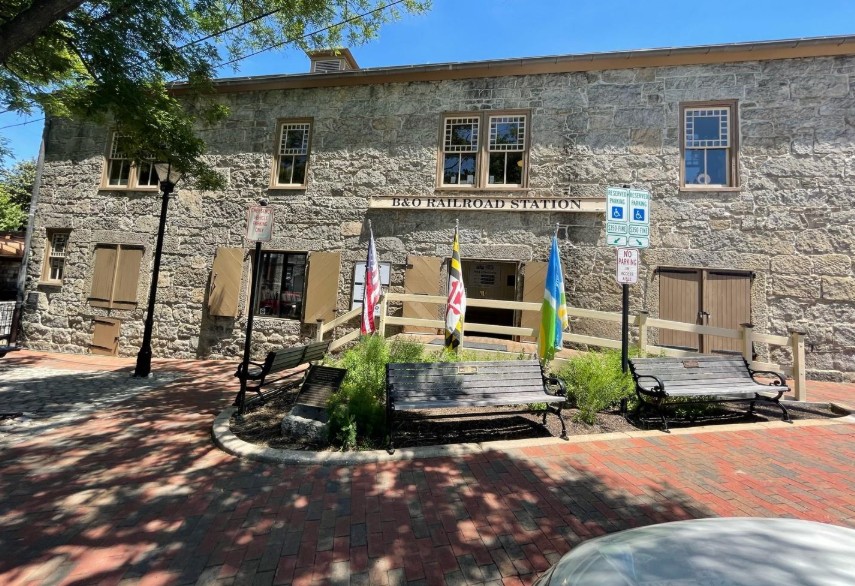
The Baltimore & Ohio (B&O) Ellicott City Station Museum is the oldest surviving railroad station in the United States. (MDOT/Jena Queen)
As Maryland prepares to commemorate America’s 250th anniversary, transportation history offers a unique lens to reflect on growth and development. Few places tell that story better than the Baltimore & Ohio (B&O) Ellicott City Station Museum.
The museum is the oldest surviving railroad station in the United States. It is a landmark that represents the beginning of America’s railroad innovations and Maryland’s role as a transportation leader.
The B&O Ellicott City Station is named for its point of origin, Baltimore, and its intended destination, the Ohio River. The B&O railroad was founded in 1827 as the first common carrier railroad in the United States.
Passenger service to Ellicott’s Mills, now Ellicott City, began in May 1830. Initially, travelers rode in horse-drawn railcars. Later that same year, in August, the B&O demonstrated the first American-built steam locomotive, known as the Tom Thumb.
Built in 1831 as a freight depot, the Ellicott City Station was renovated to accommodate passengers. Although passenger service ended in 1949 and freight service ended in 1972, the station’s significance was recognized through its designation as a National Historic landmark in 1968.
During a visit to the museum, I toured and spoke with Conor Conneally, the museum manager, about any 250 celebrations, attractions and preservation projects. The museum is preparing to host activities this summer. “We are part of Howard County’s 250. We are going to be used as a venue for a couple of different events throughout the year,’’ Conneally said.
Interest in the museum continues to grow. Following recent media coverage and increased visitation to historic Ellicott City, the museum is anticipating a busy summer season. Conneally stated that “July is usually our busiest time of year, depending on the weather… We’ll probably get a lot more people coming this summer. Ellicott City’s been busy this spring, so we’re hoping the summer will be good.”
The model railroad and Caboose are among the museum’s most popular attractions, helping visitors visualize what traveling looked like during the 19th and 20th centuries. “Our model railroad was built by the Mount Clare Division of the National Model Railroad Association,” said Conneally. “Construction began in 1974 and was completed in 1976 by a team of volunteers led by Richard Daniels.”
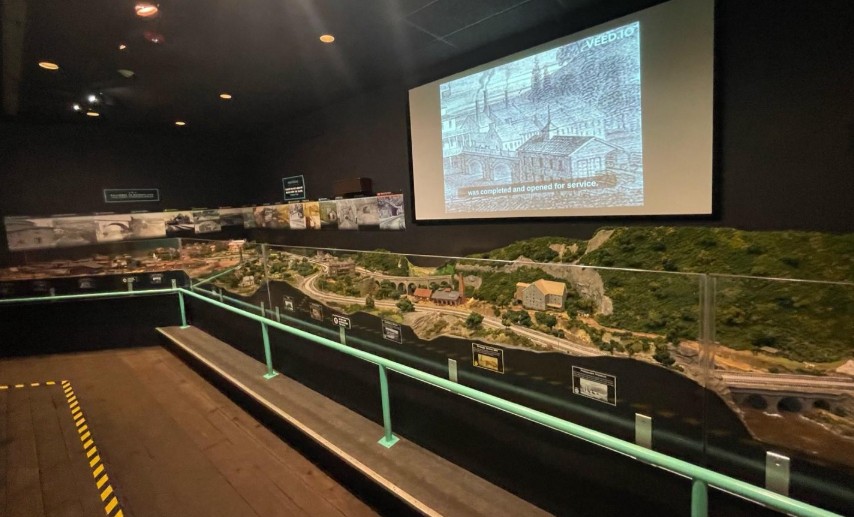
At the Baltimore & Ohio (B&O) Ellicott City Station Museum, the Freight House houses a HO-scale model depicting the first 13 miles of the B&O Railroad from Baltimore to Ellicott City. (MDOT/Jena Queen)
At the Baltimore & Ohio (B&O) Ellicott City Station Museum, the Freight House houses a HO-scale model depicting the first 13 miles of the B&O Railroad from Baltimore to Ellicott City. (MDOT/Jena Queen)
The HO-scale model railroad depicts the first 13 miles of the Baltimore and Ohio Railroad between Baltimore and Ellicott City. “The layout features several landmarks along the line, including the Mount Clare Rail Yards in Baltimore, home to the B&O Railroad Museum today; the Thomas Viaduct at Relay, one of the largest bridges in America when it was completed in 1835; and the Ellicott City Station, shown as it would have appeared in the 19th century, complete with its turntable and passenger platforms,” said Conneally. He noted that maintaining the exhibit is a labor of love for a dedicated group of volunteers. They are celebrating the model’s 50-year anniversary as the station first opened to the public in 1976.
Volunteers come in a couple times a week to look after the model and make sure it’s running smoothly. The model trains aren’t designed to run all day, and they can gain a lot of mileage when the museum is busy.
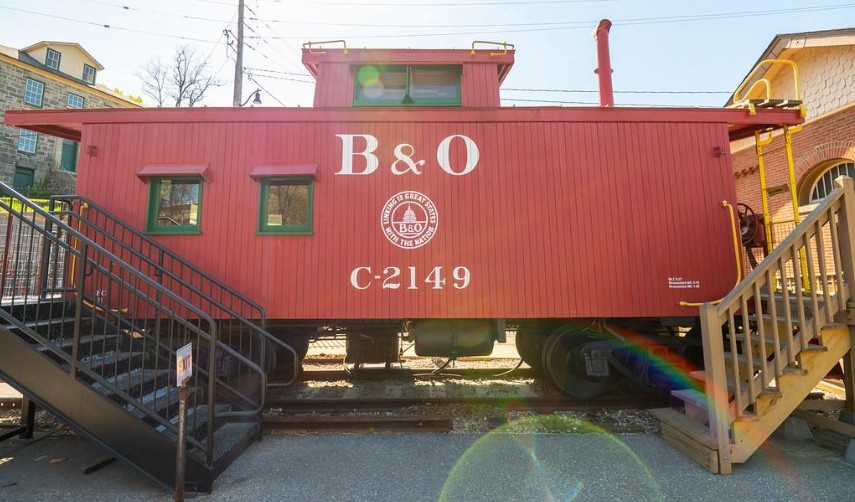
The recently restored Caboose was built in 1927. (MDOT/Jena Queen)
Built in 1927, and one of 400, is Caboose No. C2149, another popular attraction which served an important operational purpose on the railroad. “[It’s] a safety car. Its main function was making sure the train was running safely,” Conneally explained, adding that the air brake was used by the brakeman. “[The brakeman] would sit in the cupola seat and would use the windows to observe the train, making sure the train was running safely, making sure nothing’s coming up… changing switches, getting train orders.”
The caboose recently underwent a major restoration, helping to preserve it for future generations. Preserving a nearly 200-year-old transportation landmark comes with its challenges. From weather exposure to aging, maintaining historic structure requires constant attention.
“Age and wear and tear are consistent issues,” Conneally said. “If you don’t put in any [work towards maintaining/preserving], it will continue to degrade, which is an issue of restoration … you have to keep on top of projects like that.”
For Conneally, the museum’s mission extends beyond preserving a building. It is about preserving history. “We want to communicate the importance of history. It’s an important part of Ellicott City and Maryland because it was the first terminus railroad,’’ he said. “It is a unique kind of building. It is a unique historical structure, the fact that it’s still on active rail track.”
The connection between past and present is visible every day at the museum. CSX trains still pass along the active rail next to the station, reminding visitors that rail transportation continues to play a vital role in Maryland’s transportation network.
The B&O Ellicott City Station Museum is open for self-guided touring from 10 a.m. – 3 p.m. Wednesdays and Thursdays; and from 10 a.m. – 5 p.m. Friday -Sunday. Admission is free. To view more details, visit their website.
Jena Queen an intern with the Maryland Department of Transportation.