
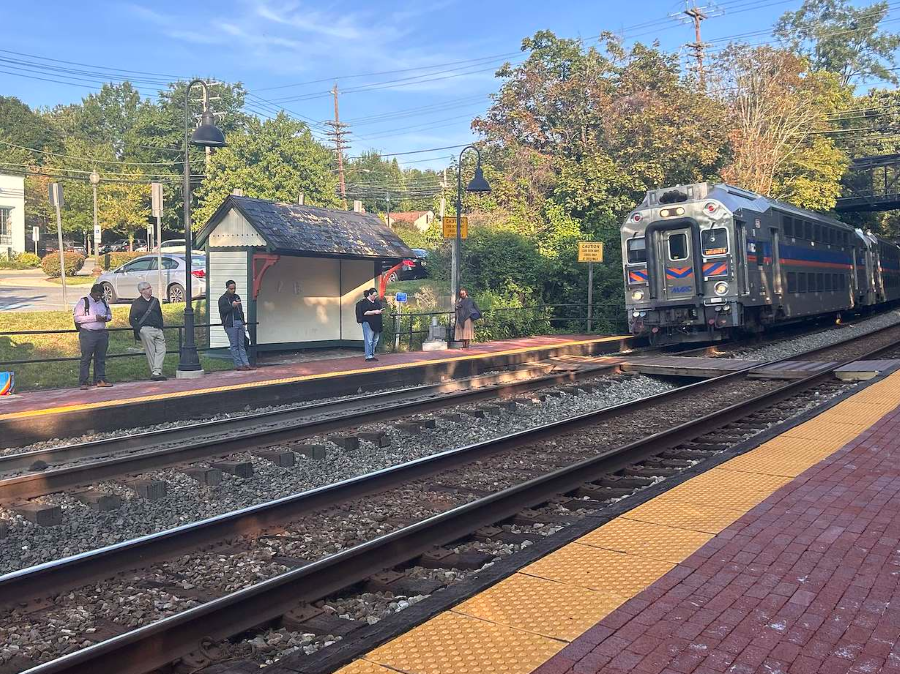
The Germantown MARC train station, one of many stations included in the Washington Suburban Transit Commission’s transit-oridented development study. (MDOT)
The Maryland Department of Transportation is partnering with private developers to transform underused public land across the state into mixed-use communities with housing, offices and retail conveniently just steps from MARC, Light Rail and Metro stations.
You may have heard about MDOT’s transit-oriented development (TOD) projects moving forward at the Bowie State MARC Station, Rogers Avenue Metro Station and elsewhere, but the State is also working to keep the broader development pipeline flowing by making progress on longer-term TOD opportunities. The Washington Suburban Transit Commission (WSTC), in partnership with MDOT’s Office of Real Estate and Economic Development, is working to expedite development at longer-term TOD opportunity commuter rail sites through its recently published TOD Strategy Study. The study seeks to inform key early-phase decisions at the Seabrook MARC Station in Prince George’s County, and for the first time, establish a cohesive vision for TOD along the MARC Brunswick Line in Montgomery County.
These locations often present challenges to TOD, but by addressing these roadblocks and beginning to lay the groundwork for the future, the State could unlock approximately 1,200 housing units, $124 million in local tax revenue and 134,000 new annual MARC trips.
Bringing Long-Term Opportunities to Fruition
The study found the greatest TOD potential at the Seabrook MARC Station exists with encouraging private development through land assemblage, such as economic and tax incentives, and building a more robust market for development through improved multi-modal infrastructure and potential civic facilities at the station. Given the lack of publicly-owned land, other solutions could include establishing a right of first refusal to acquire land from any private owners, which may lead to a more promising joint development project. Lastly, the study recommended that the State and Prince George’s County work together to advance transportation improvements along the adjacent State highway, as well as construct other multi-modal connections to the station.
The MARC Brunswick Line portion of the study recommended Montgomery County and the City of Gaithersburg pursue state TOD designations at Germantown and Metropolitan Grove, making them eligible for MDOT’s TOD Capital Grant and Revolving Loan Fund and other benefits. Additionally, the State will support Montgomery County as it continues to pursue TOD on its property at the Germantown Station, where it hopes to create a regional parking and access strategy with Metropolitan Grove, to optimize for the best balance between park-and-ride customers and future development.
What’s Next?
The studies that were completed in 2026 now transition to implementing the findings and recommendations that bring forward the timelines of these TOD initiatives. By starting now, the State can begin to build toward a future that advances what Maryland residents need most: housing, jobs, and opportunity.
For updates and detailed project information, visit the Washington Suburban Transit Commission website or follow their LinkedIn page.
Ryan Traher is a transit analyst with the Washington Suburban Transit Commission.