

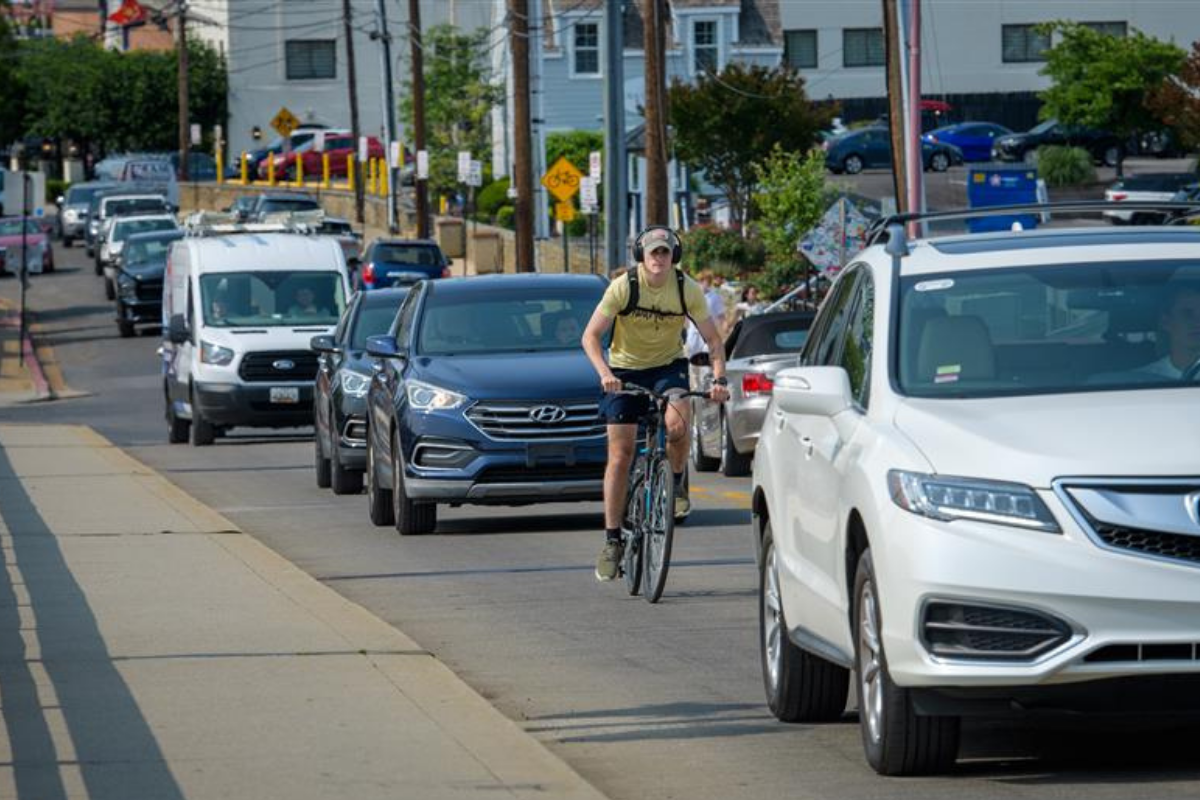
MDOT legislations would help make roadways safer for all users, including the most vulnerable to get around by foot or in two wheels. (MDOT).
There’s a flurry of activity once again in Annapolis with the 2026 Legislative Session underway. The annual gathering of state lawmakers is also an opportunity for MDOT to continue pushing forward its Serious About Safety efforts. The work involves expediting progress and sharply bending the curve on roadway fatalities and serious injuries across the state. As MDOT continues to improve its safety programs, there is also the need to gain access to deploy new key safety tools.
“A core component of Serious About Safety is looking at new authorities or expanded authorities that would give MDOT and our local partners more tools in the toolbox to make our roadways and transportation system safer,” said Jonathan Rogers, Policy Advisor at MDOT. “Accessing these tools requires collaboration, support and action from the General Assembly.”
Amid the hundreds of bills lawmakers are considering this legislative session, MDOT is pursuing three pieces of legislation that target dangerous driving behavior and impairment. Below is a list of the Department’s safety bills and what the measures aim to accomplish.
SB0173/HB0249 – Vehicle Laws – Automated Enforcement – Reciprocal Agreements, Arrangements, and Declarations
“We know automated enforcement, such as speed and red-light cameras, is a tool that works,” said Rogers. “It slows people down and prevents aggressive driving, but a major loophole is the inability for the state to enforce scofflaws who reside and register their vehicles in other states.” To correct the loophole, MDOT is sponsoring a bill that would allow the Motor Vehicle Administration to enter into reciprocal agreements with other states to flag vehicle registrations for automated enforcement violations.
For example, if a driver from out of state did not pay for their speeding or red-light tickets from Maryland, the driver’s home state would prevent them from renewing their vehicle registration until the Maryland tickets are paid, and vice versa.
HB0256 – The Vulnerable Road User Protection Act of 2026

MDOT is seeking authority to use automated speed enforcement outside work zones. (David Trozzo/MDOT)
Of the 480 people killed on Maryland roads in 2025, 24% were vulnerable road users – those who walk, bike or roll. In an effort to save lives, MDOT reintroduced its Vulnerable Road User Protection Act. Outside of work zones, the state does not have the authority to use automated speed enforcement tools on major safety corridors. The legislation would expand the ability of the State Highway Administration and local governments to work collaboratively to implement automated speed enforcement on corridors that have been identified as high-risk for vulnerable users. Using speed cameras to get drivers to slow down would complement MDOT’s Complete Streets work and address safety concerns in areas with the greatest safety risk.
SB0038/HB0286 – Vehicle Laws – Ignition Interlock System Program – Required Participation
Another powerful device in the road safety toolbox is ignition interlocks. These breathalyzers prevent vehicles from starting if a sample of a driver’s breath shows elevated alcohol content over a pre-set limit. They also help enforce road safety while preserving a driver’s ability to access opportunity. This bill will help make ignition interlocks more accessible. If enacted, the legislation would allow the Motor Vehicle Administration to offer enrollment in the interlock program instead of a license suspension or revocation.
“These three bills will help meaningfully move the needle on safety by improving the efficacy of automated speed enforcement and providing a strong alternative to make sure people are not driving while intoxicated,” said Rogers.
You can join MDOT’s pursuit to make Maryland’s transportation system the safest in the nation. If you support these bills, let your state lawmakers know. For a guide on how to submit testimony to the General Assembly, click here.
Meredith Devereux is a Senior Writer with the Maryland Department of Transportation.